

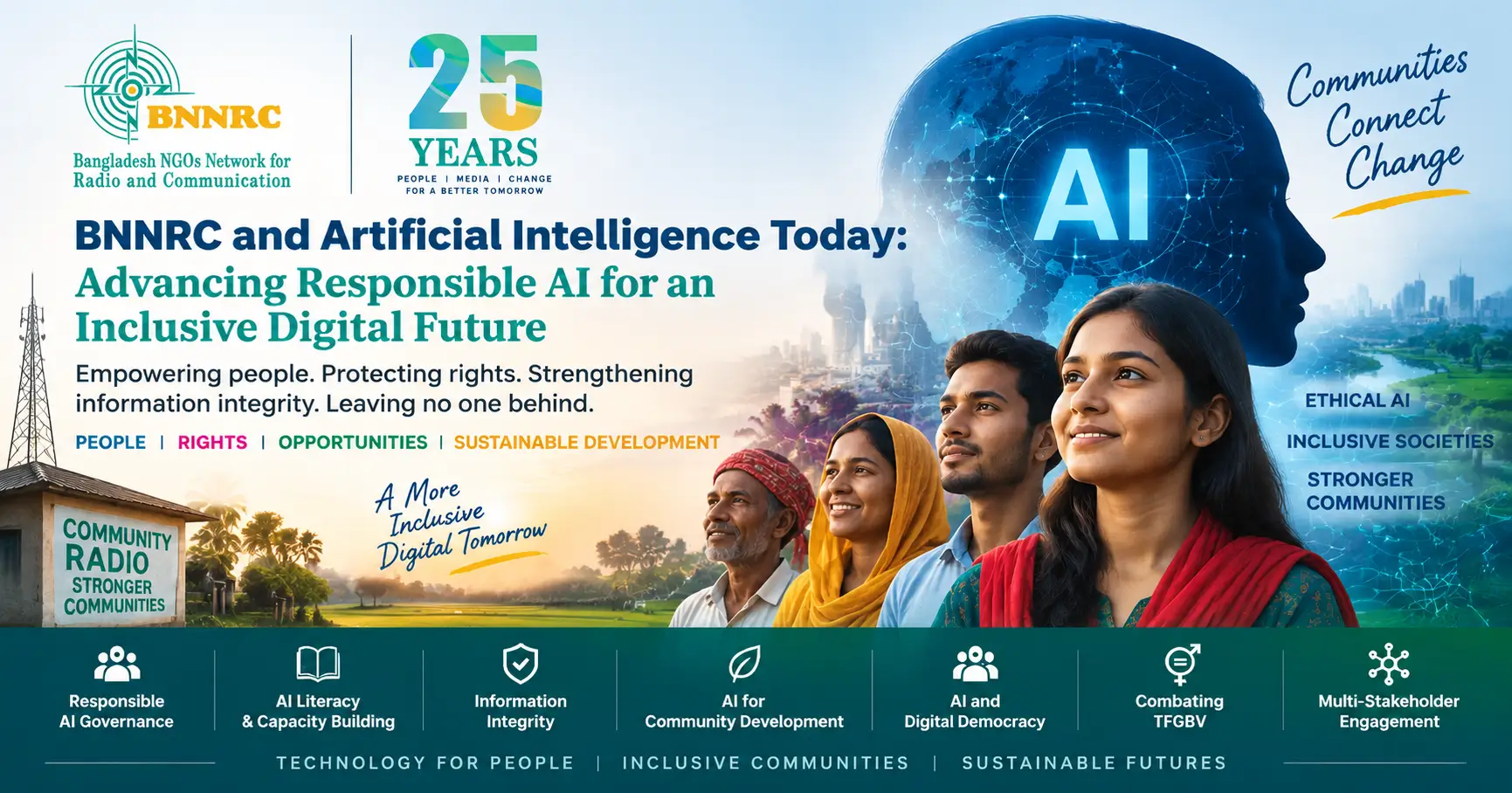
BNNRC and Artificial Intelligence Today: Advancing Responsible AI for an Inclusive Digital Future
From community media to global AI governance: BNNRC is working to ensure that Artificial Intelligence serves people, protects human rights, strengthens information integrity, and creates meaningful opportunities for underserved communities
The AI Moment: Opportunity, Responsibility, and the Need for Inclusive Governance
Artificial Intelligence (AI) is rapidly transforming societies, economies, and democratic systems. From improving access to information and public services to supporting innovation, education, healthcare, and climate resilience, AI has the potential to become a powerful driver of sustainable development.
However, the expansion of AI also brings significant challenges. Questions around transparency, accountability, privacy, misinformation, digital inequality, algorithmic bias, and the exclusion of marginalized communities have become central concerns in global technology discussions.
The future of AI cannot be shaped only by technology developers, governments, or large corporations. It must include the voices of civil society, communities, journalists, researchers, youth, women, and people who are often left behind in technological transformation.
In this changing global landscape, the Bangladesh NGOs Network for Radio and Communication (BNNRC) is emerging as a civil society organization promoting responsible, inclusive, and human-centred Artificial Intelligence (AI) for community empowerment, digital development, information integrity, and sustainable development.
BNNRC’s Approach to AI: Connecting Technology with People’s Needs
BNNRC is not an AI technology developer or a commercial AI company. Instead, BNNRC focuses on the social impact, governance, literacy, ethical use, and responsible adoption of AI. Building on more than two decades of experience in community media, communication for development, digital inclusion, and grassroots engagement, BNNRC works to ensure that emerging technologies benefit communities, particularly:
rural populations;
women and youth;
marginalized communities;
journalists and media professionals;
civil society organizations;
development practitioners.
BNNRC believes that AI must not widen existing inequalities. Rather, it should become a tool for improving access to information, strengthening participation, protecting rights, and supporting inclusive development.
The Challenge: Ensuring AI Serves Humanity
While AI creates enormous possibilities, responsible governance is essential to address emerging risks. Unregulated or poorly governed AI systems may contribute to:
misinformation and disinformation;
digital exclusion;
privacy violations;
harmful automated decisions;
reduced accountability;
increased vulnerability of marginalized communities;
technology-facilitated gender-based violence (TFGBV).
For communities with limited digital literacy and resources, the AI divide may become a new form of inequality. Therefore, BNNRC advocates for AI systems that are:
ethical;
transparent;
accountable;
inclusive;
human-rights-centred;
accessible to all communities.
BNNRC’s Key Areas of Engagement with AI
1. Promoting Responsible AI Governance
BNNRC advocates for ethical, transparent, inclusive, and accountable AI governance aligned with international responsible AI principles and human rights frameworks. The organization promotes dialogue among governments, civil society, academia, technology communities, and international partners to strengthen responsible AI ecosystems in Bangladesh and globally.
2. AI Literacy and Capacity Building
Understanding AI is essential for meaningful participation in the digital future. BNNRC works to enhance AI awareness and capacity among:
communities;
journalists;
NGOs;
development professionals;
youth;
civil society actors.
The objective is to help people understand both the opportunities and risks associated with AI and encourage responsible use of emerging technologies.
3. AI and Information Integrity
The digital information environment faces growing challenges from misinformation, disinformation, and manipulated content. BNNRC explores how AI can support:
fact-checking;
trusted information systems;
media resilience;
responsible digital communication;
protection of information integrity.
As an organization with long experience in community media and communication for development, BNNRC emphasizes that technology must strengthen, not weaken, public trust.
4. AI for Community Development
BNNRC explores practical applications of AI for development challenges, including:
digital inclusion;
disaster risk communication;
climate resilience;
community media innovation;
access to essential information;
social development initiatives.
The organization promotes technology solutions that respond to real community needs.
5. AI and Digital Democracy
Democratic societies require inclusive participation in decisions that shape technological futures.
BNNRC promotes digital democracy by advocating for:
meaningful public participation;
inclusive AI policy discussions;
community representation;
transparent digital governance.
AI development must reflect diverse languages, cultures, experiences, and social realities.
6. AI for Preventing Technology-Facilitated Gender-Based Violence (TFGBV)
Technology has created new forms of gender-based violence, including online harassment, cyberstalking, image-based abuse, and digital threats. BNNRC works to explore responsible technology approaches that support:
awareness building;
prevention mechanisms;
digital safety;
survivor-centred responses;
community resilience.
BNNRC’s Global Engagement in AI Ethics and Governance. BNNRC actively participates in global initiatives focused on responsible AI, digital cooperation, and ethical technology governance.
UNESCO Global Civil Society Organizations and Academic Network on AI Ethics and Policy
BNNRC participates in UNESCO’s global network that strengthens civil society and academic engagement in AI ethics and governance. The Network provides a platform for:
knowledge exchange;
advocacy;
collaboration;
contribution to global AI governance discussions.
The initiative supports the implementation of UNESCO’s Recommendation on the Ethics of Artificial Intelligence (2021).
Coalition for Sustainable Artificial Intelligence
BNNRC engages with the Coalition for Sustainable AI, coordinated by France, the United Nations Environment Programme (UNEP), and the International Telecommunication Union (ITU).
The Coalition promotes responsible AI development aligned with environmental sustainability goals and explores how AI can contribute to addressing global challenges.
HealthAI: The Global Agency for Responsible AI in Health
BNNRC engages with global discussions on responsible AI in health, supporting conversations around:
equitable access;
responsible innovation;
inclusive health technologies;
governance mechanisms.
Global Council for Responsible AI
BNNRC participates in discussions promoting:
ethical AI development;
transparency;
accountability;
secure and beneficial AI systems.
Digital Cooperation Organization (DCO)
BNNRC serves as an Observer Organization of the Digital Cooperation Organization (DCO), contributing to discussions on digital transformation, inclusive digital economies, and global digital cooperation.
Supporting Global Responsible AI Commitments.
Hamburg Declaration on Responsible Artificial Intelligence for the SDGs
BNNRC supports the principles of the Hamburg Declaration, which emphasizes that AI should:
uphold human rights;
support marginalized communities;
combat misinformation;
expand AI education;
encourage responsible innovation.
The Declaration highlights the importance of ensuring that developing countries can benefit from AI-driven development.
United Nations Global Digital Compact
BNNRC aligns with the vision of an open, safe, and secure digital future for all.
The Global Digital Compact recognizes that governments, civil society, technology communities, researchers, and other stakeholders must work together to ensure responsible digital transformation and AI governance.
UN Digital Cooperation Portal
BNNRC supports global efforts to track and share initiatives contributing to digital cooperation and implementation of the Global Digital Compact.
Participation in Global AI and Digital Cooperation Platforms
BNNRC actively engages in international forums including:
AI for Good Global Summit
The ITU-led AI for Good initiative provides a global platform to explore how AI can contribute to achieving the United Nations Sustainable Development Goals (SDGs).
World Summit on the Information Society (WSIS)
BNNRC contributes to the WSIS process, which promotes a people-centred, inclusive, and development-oriented information society. The WSIS framework recognizes the importance of participation from:
governments;
civil society;
private sector;
technical communities;
academia.
Internet Governance Forum (IGF)
BNNRC engages with the UN-established Internet Governance Forum, contributing civil society perspectives on:
internet governance;
digital rights;
AI;
information integrity;
emerging technologies.
UN Global Dialogue on AI Governance
BNNRC participated in the UN Global Dialogue on AI Governance, contributing perspectives on:
AI opportunities and implications;
bridging AI divides;
safe and trustworthy AI;
human rights, transparency, accountability, and human oversight.
Impact: Connecting Bangladesh with Global AI Conversations
Through its AI-related engagement, BNNRC is creating bridges between local communities and global technology governance discussions.
Its work demonstrates that responsible AI is not only a technical issue. It is also a question of:
human rights;
democracy;
inclusion;
access to information;
social justice;
sustainable development.
By bringing community perspectives into global AI discussions, BNNRC contributes to ensuring that the voices of developing countries and marginalized communities are reflected in the future of technology.
The Way Forward: A Collective Responsibility for Responsible AI
Artificial Intelligence will continue to shape the future of societies. The key challenge is not only how advanced AI becomes, but how responsibly and inclusively it is developed and used.
BNNRC calls for continued collaboration among:
governments;
technology companies;
civil society organizations;
academia;
media;
communities;
international organizations.
Together, stakeholders must work to:
strengthen responsible AI governance;
expand AI literacy;
protect information integrity;
reduce digital and AI divides;
promote human-centred innovation;
ensure AI contributes to dignity, equality, and sustainable development.
BNNRC believes that the future of Artificial Intelligence must be shaped not only by those who build technology, but also by those whose lives are transformed by it. A responsible AI future is possible when every community has the opportunity to participate, benefit, and have its voice heard.