
Strengthening Resilience Against Technology Facilitated Gender Based Violence (TFGBV) & Promoting Digital Development

Technology Facilitated Gender Based Violence (TFGBV) & Digital Development in Bangladesh
Over the past 24 years, digital technologies in Bangladesh have fostered economic growth, expanded commerce, and accelerated the development of new industries. They have also played a crucial role in connecting activists and marginalized communities, amplifying their voices, and strengthening democracy and human rights.
These technologies have facilitated information flow and played a crucial role in promoting citizen education and political participation. They have enhanced the efficiency, transparency, and accountability of government systems and service delivery and supported organizing and advocacy efforts, which have helped strengthen democratic institutions, processes, and values.
Despite the undeniable benefits, the rapid pace of technological innovation has outpaced our ability to fully assess and mitigate potential negative impacts. This underscores the urgent need for a comprehensive assessment of these impacts. The increasing integration of social media platforms, big data, and algorithmic decision-making into our lives and governance has significantly transformed the political and economic landscape over the past 24 years.
This is to promote practices that respect rights and ensure accountability for upholding human rights obligations across the digital ecosystem. These interventions could strengthen civic actors’ capacity to monitor, advocate, and influence the government and the private sector. Efforts could focus on fostering greater collaboration and knowledge-sharing by supporting global or regional networks of civil society actors.
Support could also be provided for monitoring, advocacy, and reporting of technology-facilitated human rights violations, conducting digital security audits, and strengthening community emergency response teams, hotlines, and other forms of rapid support to civic actors experiencing cyberattacks.
Digital Development utilizes ICT to amplify communities’ efforts to accelerate social, political, and economic development. These solutions enable countries to leverage technological innovations, reduce poverty, and advance progress toward the Sustainable Development Goals.
The widespread use of social media in Bangladesh has led to an increase in technology-facilitated gender-based violence (TFGBV). Gender-based violence facilitated by technology includes acts such as cyberstalking, online harassment, photo abuse, and hacking. These actions have severe consequences for the well-being and safety of women and girls, often leading to offline violence.
TFGBV occurs online and in the digital space, using any technology, whether old or new, including phones, GPS tracking devices, drones, or any recording device not connected to the internet. Technology permeates every aspect of our lives, and the Sustainable Development Goals rightly name universal internet access as an essential step in addressing gender inequality.
Project Budget-355,47,441 BDT
Project Period: 15 May 2025 to 14 May 2027
Goal:
Envision a Bangladesh where inclusive, secure digital development empowers CSOs to foster an advancing digital democracy, enabling meaningful participation in public life for women and girls, in all their diversity, by countering TFGBV and gendered disinformation.
Objectives
Create awareness and resilience by strengthening national and community-based systems that prevent and mitigate TFGBV and by enabling survivors, particularly youth, including women, girls, marginalized communities, and those at risk of TFGBV, to access specialized care and support.
Foster community-driven solutions, networking, and partnerships to create a safer digital space and digital development.
Support advocacy efforts for better regulations, protections, and support services related to TFGBV at the national and regional levels.
Equip CSOs with a comprehensive understanding, knowledge, skills, and resources to identify, report, and prevent TFGBV.
Outcome
Increased outreach to and mobilization of diverse citizens at all levels
Expanded cooperation, partnerships, and networks among civil society entities and organizations
Increased interaction and dialogue between civil society entities, individual
citizens, and GOB representatives towards more responsive and inclusive policies
Increased capacities of civil society organizations and community leaders
Outcome-based outputs and activities
Objective
Create awareness and resilience by strengthening national and community-based systems that prevent and mitigate TFGBV and by enabling survivors, particularly youth, including women, girls, marginalised communities, and those at risk of TFGBV, to access specialised care and support.
Outcome 1:
Increased outreach to and mobilization of diverse citizens at all levels
Output 1.1:
Civil society initiatives reach more and diverse citizens, especially women, youth, and members of marginalized communities.
Output 1.2:
Civil society initiatives successfully mobilize diverse citizens
Activities
1. Baseline and Endline Surveys: Conduct baseline and endline surveys
2. Explainer on TFGBV and Digital Development:
3. Workshop for Community Radio Broadcasters
4. Community Radio Program
5. Online Campaign through Hyperlocal Method on TFGBV
6. Media Briefing on Day Observation
Objective
Foster community-driven solutions, networking and partnerships to create a safer digital space and digital development.
Outcome 2:
Expanded cooperation, partnerships, and networks among civil society entities (organizations)
Output 2.1:
Civil society establishes and/or strengthens alliances to enhance its influence on policy and decision-making, hold the government accountable, and advocate for democratic reforms.
Output 2.2:
Civil society alliances engage in collective advocacy on CEF themes.
Activities
1. National-level consultation with technology platforms
2. Dialogue with Journalists
3. Round tables with Daily National Newspaper and publication of supplements
4. Digital Stories on Most Significant Changes:
5. Explainer on SDG 5 (b) and SDG 16:
6. Multi-stakeholder community talks at the district level
7. Follow-up multi-stakeholder community talks at the district level:
8. Issue-based Advocacy meeting on TFGBV and Digital Development: Objective
Objective
Support advocacy efforts for better regulations, protections, and support services related to TFGBV at the national and regional levels.
Outcome 3
Increased interaction and dialogue between civil society entities, individual citizens, and GOB representatives towards more responsive and inclusive policies
Output 3.1
Civil society initiates interactions and dialogues with the GoB on governance themes at all levels.
Activities
1. Consultative and integration meeting at the National Level
2. Consultations with the Legal Aid Officer at the district level
3. Follow-up Consultations with the Legal Aid Officer at the District Level
4. Public Hearings on TFGBV-related applications:
Objective
Equip CSOs with a comprehensive understanding, knowledge, skills, and resources to identify, report, and prevent TFGBV.
Outcome 4
Increased capacities of civil society organizations and community leaders
Output 4.1
CSO personnel, especially women, receive training to enhance their technical knowledge and organizational skills
Activities
1. Training of Trainers on TFGBV and Digital Development
2. Refresher Training on TFGBV and Digital Development
3. Capacity-building workshop with CSOs:
4. Follow-up Mentoring workshop with CSOs:
5. Capacity-building Workshop for local media professionals:
6. Bangladesh School of TFGBV
7. Annual National Conference
8. Orientation on YouTube and Content Creators
Geographical Area Covered:
Fourteen (14) Districts: Satkhira, Kushtia, Barishal, Patuakhali, Pirojpur, Mymensingh, Barguna, Bhola, Chattogram, Noakhali, Moulvibazar, Kurigram, Jhenaidah, and Gaibandha, covering a total of 14 upazilas and 84 Unions.
Estimated Number of Beneficiaries:7,25,680
Direct Beneficiaries: 3,253
Indirect Beneficiaries: 722427
Social Media Audience:
Stakeholders
CSOs/ think tanks, Academia, Women Decision-Makers (WDMs), Human Rights Defenders (WHRDs), members of local cultural organizations, and members of the Bangladesh Women Internet Governance Forum.
Local Focal Organizations: Nishtha Unnayan Sangho (NUS), Mymensingh; SETU, Kushtia; Pirojpur Gana Unnayan Samity (PGUS), Pirojpur; Map Bangladesh, Barishal; Sukhtara Mahila Sangstha, Patuakhali.
Project Aligns with SDGs: SDG 5 & SDG 16
Facilitating Partner: GFA Consulting Group
Development Partners: Embassy of Switzerland, Global Affairs Canada and the European Union (EU) Achievement so far
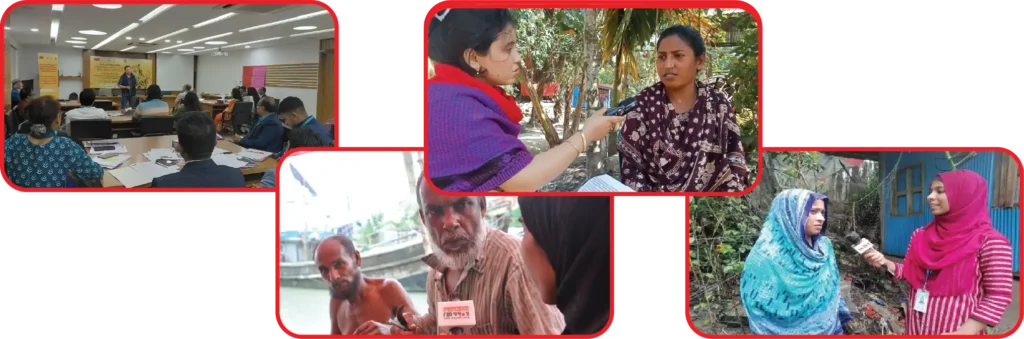
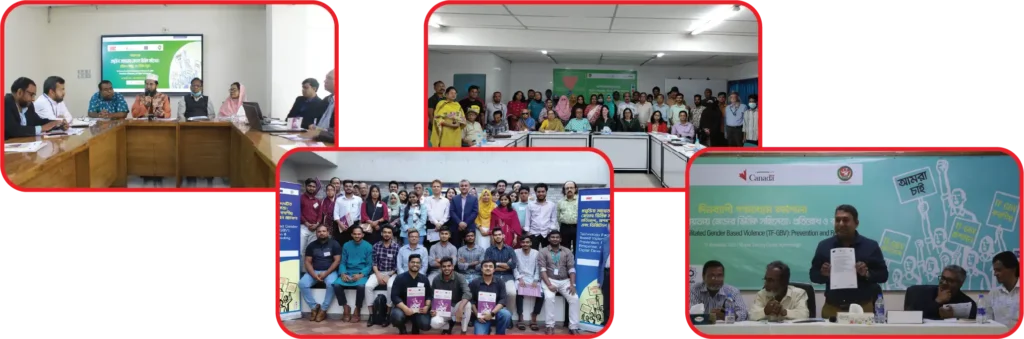
Program organized in Dhaka
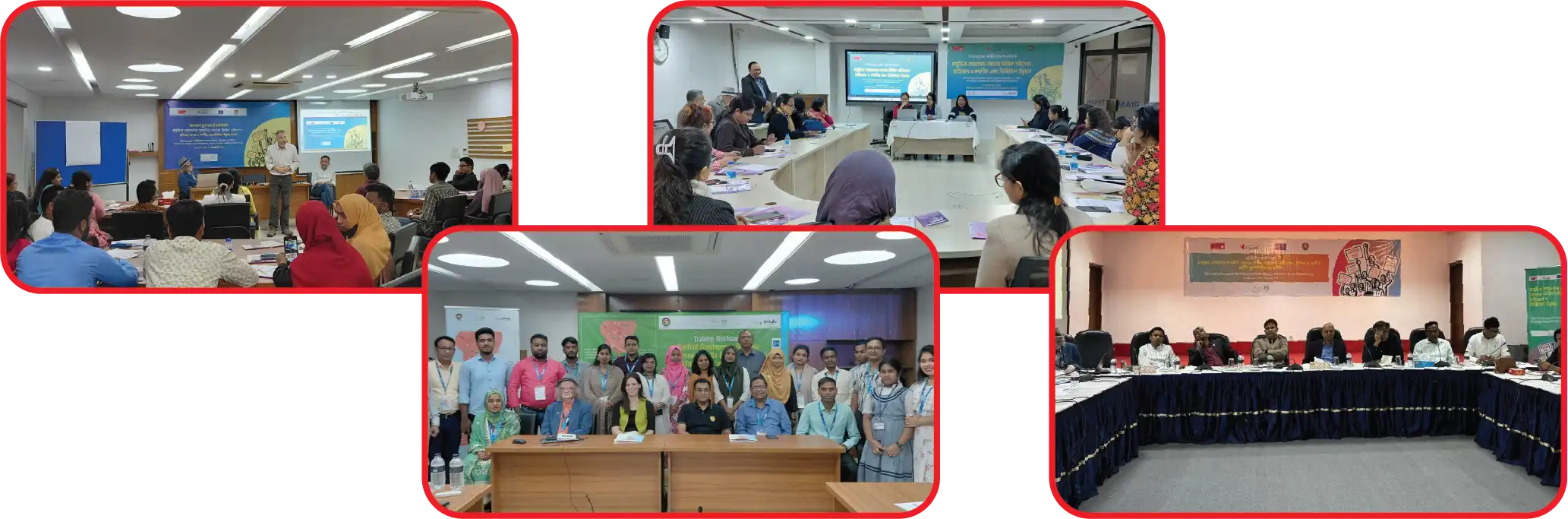
Organized a workshop for Community Radio Broadcasters in Dhaka: The workshop brought together 18 senior program producers and station managers from nine community radio stations, equipping them with the skills, strategies, and tools to create audience-centered programming and social media content that addresses TFGBV while fostering inclusive digital development.
Training of Trainers on TFGBV & DD in Dhaka: organized a three-day Training of Trainers on the prevention, mitigation, and response to TFGBV and promoting Digital Development. A total of 25 journalists, local NGO and CSO representatives, lawyers, and human rights activists from various districts, including Dhaka, Pirojpur, Barishal, Patuakhali, Mymensingh, Satkhira, and Kushtia.
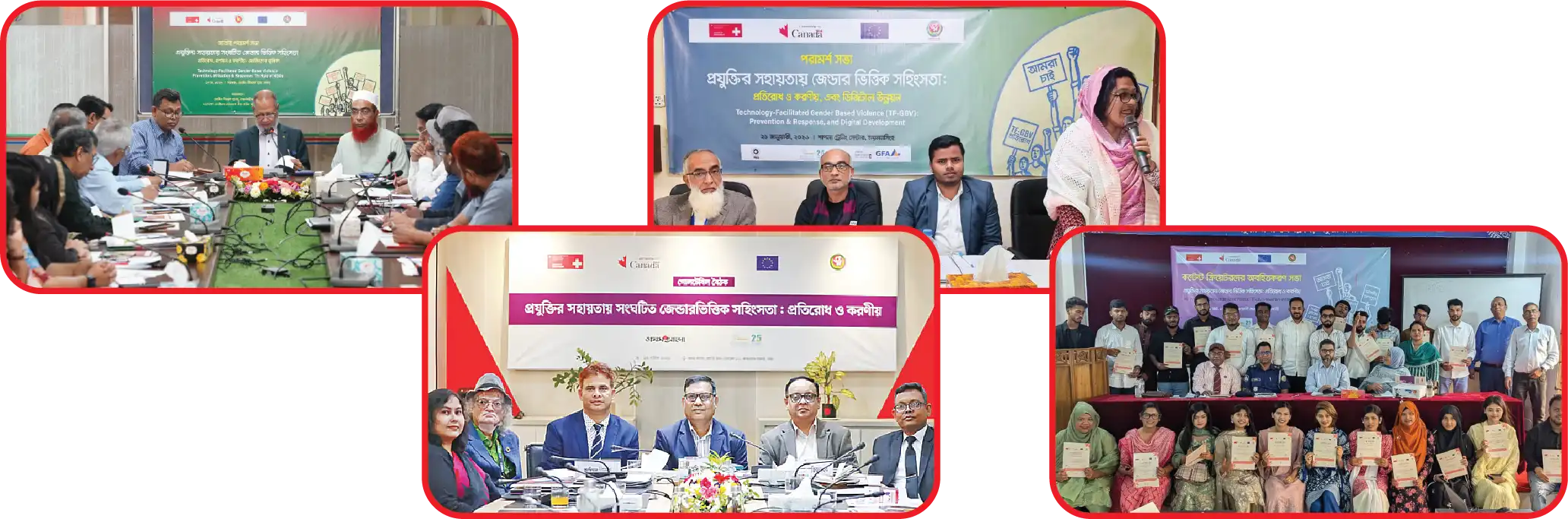
Dialogue with Journalists: A dialogue with journalists on TFGBV: Prevention and Response and promoting digital development was organized, with thirty (30) journalists from national-level print, electronic, and online media based in Dhaka participating in the interactive dialogue.
Roundtable with Daily Prothom Alo: Organized a Roundtable with Prothom Alo and published a full-page supplement. It aimed to determine the way forward to reduce TFGBV, and the supplement highlighted the issues discussed.
Consultation Meeting with Technology Platforms: A day-long consultation was organized in Dhaka. Speakers at the national consultation emphasized the need for coordinated policies, accountability, and increased awareness to prevent, mitigate, and respond to TFGBV amid the rapid expansion of digital technologies.
School of TFGBV: Two-day specialized training program on TFGBV: Prevention, Mitigation, Response, and Digital Development Campaign, held in Dhaka. The program brought together 90 participants from Dhaka and different districts across the country.
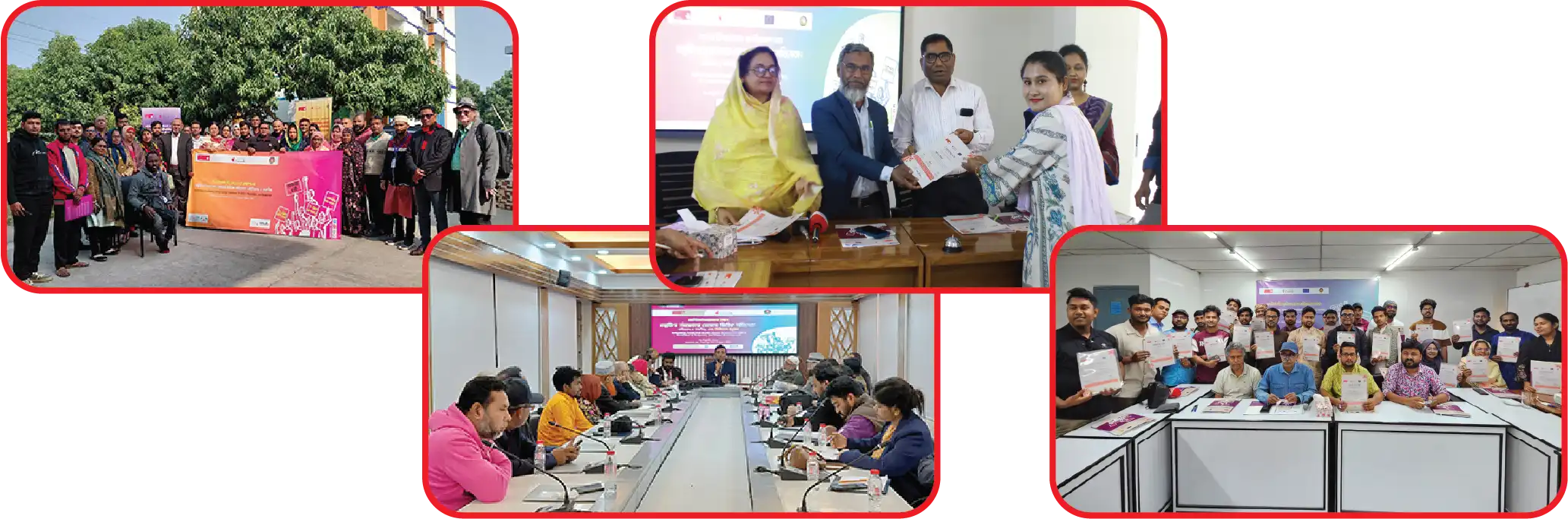
Consultation and Integration Meeting with NGOAB: The NGO Affairs Bureau under the Prime Minister’s Office and the BNNRC jointly organized a national consultation titled “TFGBV: Prevention, Mitigation, Necessary Actions, and the Role of NGOs” at the conference room of the NGO Affairs Bureau. The consultation meeting focused on TFGBV, digital development, its psychological and social impacts, prevention and response, and legal challenges related to access to justice. The discussion also highlighted how NGOs can integrate TFGBV prevention measures into their ongoing and future programs and activities.
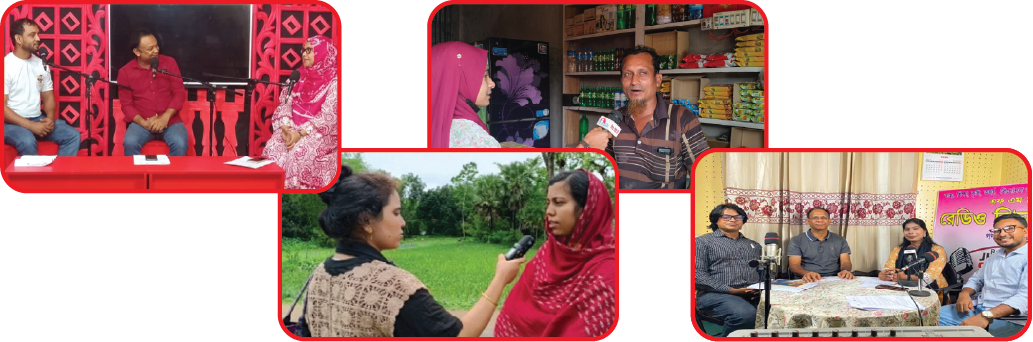
Program organized at the District level
Multi-stakeholder talks at six project districts (Satkhira, Kushtia, Barishal, Patuakhali, Pirojpur and Mymensingh) with 263 participants, including 189 males and 74 females.
Consultation with Legal Aid (Satkhira, Kushtia, Barishal, Patuakhali, Pirojpur and Mymensingh) with 246 participants, including 183 males and 63 females.
Orientation for Content Creators (Satkhira, Kushtia, Barishal, Patuakhali, Pirojpur and Mymensingh) with 250 participants, including 203 males and 47 females.
Capacity Building Workshop for Local Media Professionals (Satkhira, Kushtia, Barishal, Patuakhali, Pirojpur and Mymensingh) with 247 participants, including 238 males and 9 females.
Capacity Building Workshop for CSOs (Satkhira, Kushtia, Barishal, Patuakhali, Pirojpur and Mymensingh) with 228 participants, including 156 males and 72 females
Day Observation: Int’l Day of Rural Women (Satkhira, Kushtia, Barishal, Patuakhali, Pirojpur, Mymensingh, Barguna, Bhola, Chattogram, Noakhali, Moulvibazar, Kurigram, Jhenaidah, and Gaibandha) with 230 participants in the International Rural Women Day IRWD) event.
Day Observation: 16 Days Activism for Violence Against Women and Children (Satkhira, Kushtia, Barishal, Patuakhali, Pirojpur, Mymensingh, Barguna, Bhola, Chattogram, Noakhali, Moulvibazar, Kurigram, Jhenaidah, and Gaibandha) with 266 Participants in the International Day of Violence against Women.
Day Observation: International Women’s Day (Satkhira, Kushtia, Barishal, Patuakhali, Pirojpur, Mymensingh, Barguna, Bhola, Chattogram, Noakhali, Moulvibazar, Kurigram, Jhenaidah, and Gaibandha) with 162 participants in the International Women’s Day (IWD) event.
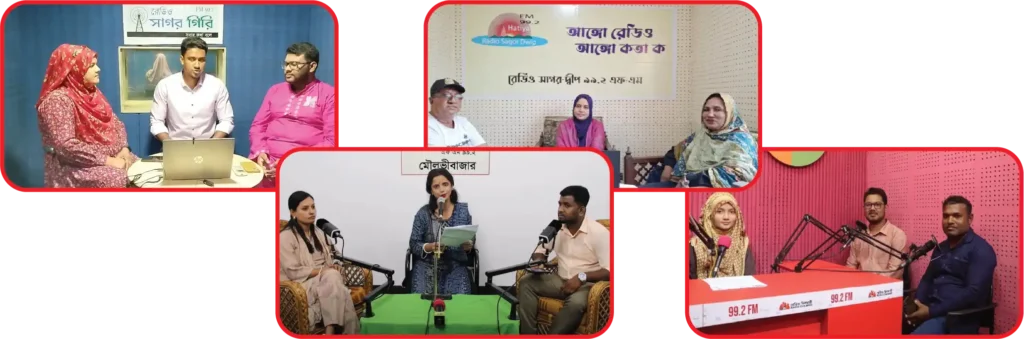
Community Radio Program
Produced and broadcast 162 community radio programs through a network of nine community radio stations, covering 18 thematic episodes on TFGBV prevention, mitigation, and digital safety. Community Radio Nalta, Radio Lokobetar, Radio Meghna, Radio Sagorgiri, Radio Sagordwip, Radio Pollikontho, Radio Chilmari, Radio Jhenuk, and Radio Sarabela.
BNNRC is implementing the project titled “Strengthening Resilience Against Technology-Facilitated Gender-Based Violence (TFGBV) and Promoting Digital Development.” The project is being implemented under the Nagorikata: Civic Engagement Fund (CEF) programme, funded by Switzerland, Global Affairs Canada, and the European Union, with technical support from GFA Consulting Group.