
From community media to global AI governance: BNNRC is working to ensure that Artificial Intelligence serves people, protects human rights, strengthens information integrity, and creates meaningful opportunities for underserved communities
The AI Moment: Opportunity, Responsibility, and the Need for Inclusive Governance
Artificial Intelligence (AI) is rapidly transforming societies, economies, and democratic systems. From improving access to information and public services to supporting innovation, education, healthcare, and climate resilience, AI has the potential to become a powerful driver of sustainable development.
However, the expansion of AI also brings significant challenges. Questions around transparency, accountability, privacy, misinformation, digital inequality, algorithmic bias, and the exclusion of marginalized communities have become central concerns in global technology discussions.
The future of AI cannot be shaped only by technology developers, governments, or large corporations. It must include the voices of civil society, communities, journalists, researchers, youth, women, and people who are often left behind in technological transformation.
In this changing global landscape, the Bangladesh NGOs Network for Radio and Communication (BNNRC) is emerging as a civil society organization promoting responsible, inclusive, and human-centred Artificial Intelligence (AI) for community empowerment, digital development, information integrity, and sustainable development.
BNNRC’s Approach to AI: Connecting Technology with People’s Needs
BNNRC is not an AI technology developer or a commercial AI company. Instead, BNNRC focuses on the social impact, governance, literacy, ethical use, and responsible adoption of AI. Building on more than two decades of experience in community media, communication for development, digital inclusion, and grassroots engagement, BNNRC works to ensure that emerging technologies benefit communities, particularly:
rural populations;
women and youth;
marginalized communities;
journalists and media professionals;
civil society organizations;
development practitioners.
BNNRC believes that AI must not widen existing inequalities. Rather, it should become a tool for improving access to information, strengthening participation, protecting rights, and supporting inclusive development.
The Challenge: Ensuring AI Serves Humanity
While AI creates enormous possibilities, responsible governance is essential to address emerging risks. Unregulated or poorly governed AI systems may contribute to:
misinformation and disinformation;
digital exclusion;
privacy violations;
harmful automated decisions;
reduced accountability;
increased vulnerability of marginalized communities;
technology-facilitated gender-based violence (TFGBV).
For communities with limited digital literacy and resources, the AI divide may become a new form of inequality. Therefore, BNNRC advocates for AI systems that are:
ethical;
transparent;
accountable;
inclusive;
human-rights-centred;
accessible to all communities.
BNNRC’s Key Areas of Engagement with AI
1. Promoting Responsible AI Governance
BNNRC advocates for ethical, transparent, inclusive, and accountable AI governance aligned with international responsible AI principles and human rights frameworks. The organization promotes dialogue among governments, civil society, academia, technology communities, and international partners to strengthen responsible AI ecosystems in Bangladesh and globally.
2. AI Literacy and Capacity Building
Understanding AI is essential for meaningful participation in the digital future. BNNRC works to enhance AI awareness and capacity among:
communities;
journalists;
NGOs;
development professionals;
youth;
civil society actors.
The objective is to help people understand both the opportunities and risks associated with AI and encourage responsible use of emerging technologies.
3. AI and Information Integrity
The digital information environment faces growing challenges from misinformation, disinformation, and manipulated content. BNNRC explores how AI can support:
fact-checking;
trusted information systems;
media resilience;
responsible digital communication;
protection of information integrity.
As an organization with long experience in community media and communication for development, BNNRC emphasizes that technology must strengthen, not weaken, public trust.
4. AI for Community Development
BNNRC explores practical applications of AI for development challenges, including:
digital inclusion;
disaster risk communication;
climate resilience;
community media innovation;
access to essential information;
social development initiatives.
The organization promotes technology solutions that respond to real community needs.
5. AI and Digital Democracy
Democratic societies require inclusive participation in decisions that shape technological futures.
BNNRC promotes digital democracy by advocating for:
meaningful public participation;
inclusive AI policy discussions;
community representation;
transparent digital governance.
AI development must reflect diverse languages, cultures, experiences, and social realities.
6. AI for Preventing Technology-Facilitated Gender-Based Violence (TFGBV)
Technology has created new forms of gender-based violence, including online harassment, cyberstalking, image-based abuse, and digital threats. BNNRC works to explore responsible technology approaches that support:
awareness building;
prevention mechanisms;
digital safety;
survivor-centred responses;
community resilience.
BNNRC’s Global Engagement in AI Ethics and Governance. BNNRC actively participates in global initiatives focused on responsible AI, digital cooperation, and ethical technology governance.
UNESCO Global Civil Society Organizations and Academic Network on AI Ethics and Policy
BNNRC participates in UNESCO’s global network that strengthens civil society and academic engagement in AI ethics and governance. The Network provides a platform for:
knowledge exchange;
advocacy;
collaboration;
contribution to global AI governance discussions.
The initiative supports the implementation of UNESCO’s Recommendation on the Ethics of Artificial Intelligence (2021).
Coalition for Sustainable Artificial Intelligence
BNNRC engages with the Coalition for Sustainable AI, coordinated by France, the United Nations Environment Programme (UNEP), and the International Telecommunication Union (ITU).
The Coalition promotes responsible AI development aligned with environmental sustainability goals and explores how AI can contribute to addressing global challenges.
HealthAI: The Global Agency for Responsible AI in Health
BNNRC engages with global discussions on responsible AI in health, supporting conversations around:
equitable access;
responsible innovation;
inclusive health technologies;
governance mechanisms.
Global Council for Responsible AI
BNNRC participates in discussions promoting:
ethical AI development;
transparency;
accountability;
secure and beneficial AI systems.
Digital Cooperation Organization (DCO)
BNNRC serves as an Observer Organization of the Digital Cooperation Organization (DCO), contributing to discussions on digital transformation, inclusive digital economies, and global digital cooperation.
Supporting Global Responsible AI Commitments.
Hamburg Declaration on Responsible Artificial Intelligence for the SDGs
BNNRC supports the principles of the Hamburg Declaration, which emphasizes that AI should:
uphold human rights;
support marginalized communities;
combat misinformation;
expand AI education;
encourage responsible innovation.
The Declaration highlights the importance of ensuring that developing countries can benefit from AI-driven development.
United Nations Global Digital Compact
BNNRC aligns with the vision of an open, safe, and secure digital future for all.
The Global Digital Compact recognizes that governments, civil society, technology communities, researchers, and other stakeholders must work together to ensure responsible digital transformation and AI governance.
UN Digital Cooperation Portal
BNNRC supports global efforts to track and share initiatives contributing to digital cooperation and implementation of the Global Digital Compact.
Participation in Global AI and Digital Cooperation Platforms
BNNRC actively engages in international forums including:
AI for Good Global Summit
The ITU-led AI for Good initiative provides a global platform to explore how AI can contribute to achieving the United Nations Sustainable Development Goals (SDGs).
World Summit on the Information Society (WSIS)
BNNRC contributes to the WSIS process, which promotes a people-centred, inclusive, and development-oriented information society. The WSIS framework recognizes the importance of participation from:
governments;
civil society;
private sector;
technical communities;
academia.
Internet Governance Forum (IGF)
BNNRC engages with the UN-established Internet Governance Forum, contributing civil society perspectives on:
internet governance;
digital rights;
AI;
information integrity;
emerging technologies.
UN Global Dialogue on AI Governance
BNNRC participated in the UN Global Dialogue on AI Governance, contributing perspectives on:
AI opportunities and implications;
bridging AI divides;
safe and trustworthy AI;
human rights, transparency, accountability, and human oversight.
Impact: Connecting Bangladesh with Global AI Conversations
Through its AI-related engagement, BNNRC is creating bridges between local communities and global technology governance discussions.
Its work demonstrates that responsible AI is not only a technical issue. It is also a question of:
human rights;
democracy;
inclusion;
access to information;
social justice;
sustainable development.
By bringing community perspectives into global AI discussions, BNNRC contributes to ensuring that the voices of developing countries and marginalized communities are reflected in the future of technology.
The Way Forward: A Collective Responsibility for Responsible AI
Artificial Intelligence will continue to shape the future of societies. The key challenge is not only how advanced AI becomes, but how responsibly and inclusively it is developed and used.
BNNRC calls for continued collaboration among:
governments;
technology companies;
civil society organizations;
academia;
media;
communities;
international organizations.
Together, stakeholders must work to:
strengthen responsible AI governance;
expand AI literacy;
protect information integrity;
reduce digital and AI divides;
promote human-centred innovation;
ensure AI contributes to dignity, equality, and sustainable development.
BNNRC believes that the future of Artificial Intelligence must be shaped not only by those who build technology, but also by those whose lives are transformed by it. A responsible AI future is possible when every community has the opportunity to participate, benefit, and have its voice heard.
From policy recognition to coordinated action: Bangladesh’s new strategic framework offers a historic opportunity to confront AMR through a One Health approach linking human health, animals, food systems, agriculture, environment, and communities
A Silent Crisis That Could Undermine Modern Medicine
A patient arrives at a hospital with pneumonia. The doctor prescribes a commonly used antibiotic. Days later, there is no improvement. A second medicine is prescribed. Then a third. The infection becomes harder to control, the hospital stay becomes longer, treatment costs rise, and a family that was already vulnerable begins facing financial pressure.
At the same time, thousands of kilometres away, antibiotics may be used routinely on a poultry farm to prevent disease caused by weak biosecurity. In an aquaculture pond, antimicrobial medicines may be used without adequate diagnosis. Pharmaceutical residues and resistant organisms may eventually enter food systems, water bodies, and the wider environment.
These events may appear disconnected. They are not.
They represent one interconnected challenge: antimicrobial resistance (AMR).
When bacteria and other microorganisms develop the ability to survive medicines designed to eliminate them, infections that were once easily treatable become more difficult, expensive, and sometimes impossible to cure.
AMR threatens far more than infectious disease treatment. Modern surgery, cancer care, intensive care, maternal healthcare, tuberculosis treatment, organ transplantation, and childhood disease management all depend on effective antimicrobial medicines.
The question facing Bangladesh is no longer whether AMR is a serious threat. The question is whether the country can build the coordinated national response required to preserve these life-saving medicines for future generations.
A Historic Policy Shift: AMR Enters Bangladesh’s Development Agenda
Bangladesh’s Five-Year Strategic Framework for Reform and Development, July 2026–June 2031, represents an important policy milestone by recognising AMR not simply as a healthcare issue but as a national development challenge.
Prepared by the General Economics Division of the Planning Commission and approved by the National Economic Council in May 2026, the framework places AMR within a broader strategy of national reform and development.
After sustained advocacy by civil society organisations and stakeholders, the Government of Bangladesh has explicitly incorporated antimicrobial resistance into the country’s five-year strategic planning framework.
This recognition deserves appreciation. However, policy recognition is only the beginning.
The real challenge is implementation. The success of Bangladesh’s AMR response will depend on whether institutions that traditionally work separately can function as one coordinated system.
Because AMR does not follow administrative boundaries.
A resistant bacteria does not know whether it originated in a hospital, poultry farm, fish pond, pharmaceutical factory, wastewater system, or community.
Therefore, Bangladesh’s response cannot remain divided between ministries and sectors.
It must become a national defence system based on the One Health approach. The Problem: AMR Is Not Only a Health Issue. Public discussion on antibiotic resistance often focuses on one important message:
Do not misuse antibiotics. That message remains essential. However, it represents only one part of a much larger challenge. AMR develops and spreads through interconnected systems:
human healthcare;
livestock production;
poultry farming;
aquaculture;
food supply chains;
pharmaceutical manufacturing;
wastewater management;
environmental ecosystems.
A hospital may improve antibiotic prescribing practices, but if resistant organisms continue to develop and circulate through other sectors, the national challenge remains unresolved. The new framework’s most significant contribution is recognising this reality.
It shifts the question from: “How can we reduce inappropriate antibiotic use among patients and doctors?”
to:
“How can we reduce the social, economic, agricultural, and environmental conditions that create and spread resistance?”
That is the essence of One Health. The Warning Signs Are Already Visible
The framework describes AMR as a “silent multiplier of failure” because it increases vulnerability across the entire health system.
If antibiotics lose effectiveness:
routine infections become more dangerous; medical procedures become riskier; hospital costs increase; families face greater financial pressure; healthcare systems become less resilient.
The framework highlights concerning resistance trends, including rising resistance to critically important antibiotics and the spread of resistant organisms associated with bloodstream infections.
These indicators are not merely scientific statistics. They represent future risks to public health, healthcare affordability, and national development. AMR is therefore not only a medical challenge.
It is a challenge to human security and economic resilience. The Opportunity: Moving from Plans to Measurable Results. One of the strengths of Bangladesh’s new framework is its focus on measurable action. The first phase, Recovery, proposes foundational reforms, including:
operationalising a National One Health Secretariat with budgetary authority;
expanding AMR surveillance networks;
conducting prescribing surveys;
establishing antimicrobial stewardship committees;
strengthening national AMR data systems linked with global surveillance platforms.
This approach is important because effective policy requires reliable evidence.
A country cannot regulate what it cannot measure.
Without accurate information about antibiotic prescribing, sales, consumption patterns, resistance trends, and environmental contamination, regulation becomes guesswork.
The Real Test: Implementation and Enforcement
The second phase, Restoration, moves beyond institutional development toward practical enforcement.
The framework proposes:
pharmacy audits;
updated treatment guidelines;
antimicrobial stewardship education for medical and veterinary professionals;
digital prescription systems;
restrictions on antibiotic growth promoters in animal feed;
residue testing in poultry and aquaculture;
nationwide awareness campaigns through SMS, community radio, and schools.
These measures recognise an important reality:
AMR is not only a medical problem.
It is also:
a behaviour problem;
a market problem;
a governance problem.
People seek antibiotics because they want quick recovery. Pharmacies may sell antibiotics because demand exists. Farmers may use antibiotics because disease outbreaks can destroy livelihoods.
Therefore, reducing AMR requires changing incentives throughout society. Primary Healthcare Must Strengthen Alongside Regulation. A major challenge will be balancing regulation with access. Restricting non-prescription antibiotic sales is necessary. However, many citizens rely on pharmacies as their first healthcare point because consultations may be costly, distant, or unavailable.
If regulation is introduced without improving affordable primary healthcare services, vulnerable communities may face new barriers.
Sustainable AMR control requires both: responsible antibiotic regulation and accessible healthcare alternatives. Agriculture and Fisheries Are Central to the Solution. The livestock sector is a critical part of Bangladesh’s AMR response.
Farmers often use antibiotics not because they ignore the risks, but because they face real economic pressures. Disease outbreaks can destroy entire poultry farms or livestock operations.
Therefore, reducing antibiotic dependency requires investment in:
vaccination;
veterinary services;
biosecurity;
diagnostics;
improved farm management.
The principle is simple:
To reduce antibiotic use, Bangladesh must also reduce infections. The same applies to aquaculture. Bangladesh’s fisheries sector supports livelihoods, nutrition, and exports. But sustainable growth requires:
fish disease surveillance;
early warning systems;
vaccine access;
water-quality monitoring;
responsible antimicrobial practices.
Regulation alone is insufficient. Farmers and producers need practical alternatives.
The Environment: The Missing Link in AMR Control. The environmental dimension of AMR has historically received less attention. However, antibiotic residues and resistant organisms can move through:
wastewater;
rivers;
agricultural land;
food systems.
The framework’s proposal for stronger wastewater treatment requirements in pharmaceutical zones, poultry farms, and aquaculture facilities is therefore a significant step. Environmental protection must become a core pillar of One Health.
Not a supporting element.
Not an afterthought.
Community Awareness and Communication Matter
The framework’s emphasis on SMS, community radio, and school-based awareness provides an important opportunity. Community communication should go beyond simple messages about antibiotic misuse.
Bangladesh needs antibiotic literacy. Awareness tells people that AMR exists. Literacy helps people understand:
when antibiotics are needed;
when they are harmful;
why completing treatment matters;
how prevention reduces antibiotic dependence.
Community radio, local organisations, health workers, farmers’ networks, and digital platforms can play a powerful role in building this understanding. Digital Technology Can Support AMR Action, But Governance Comes First. The framework proposes stronger digital health information systems and integration of AMR surveillance data.
Technology can support:
identifying resistance trends;
monitoring antibiotic consumption;
improving decision-making;
strengthening early warning systems.
However, technology cannot replace institutional discipline. A dashboard cannot compensate for poor laboratory data. Artificial intelligence cannot solve incomplete reporting.
Digital tools are only as effective as the systems behind them. The foundation must remain:
quality data, accountability, and coordinated governance.
By 2031, Success Must Be Measured by Outcomes
Bangladesh should avoid measuring AMR progress only through:
number of meetings held;
committees formed;
workshops conducted;
people trained.
Those are activities.
The real question is whether outcomes improve.
By 2031, Bangladesh should be able to answer:
Are unnecessary antibiotic sales decreasing?
Are hospitals improving antibiotic stewardship?
Are resistance trends stabilising?
Are antibiotic residues declining in food systems?
Are families facing fewer treatment failures?
Success must be measured by healthier people and stronger systems.
Call for Continued Action: A National Movement Against AMR
The greatest strength of Bangladesh’s new framework is its recognition that no single ministry can solve AMR.
Doctors, veterinarians, farmers, pharmacists, researchers, regulators, journalists, community organisations, and citizens all have roles to play.
A successful One Health response requires:
strong governance;
sustainable financing;
reliable surveillance;
institutional accountability;
public participation.
The next five years represent a critical opportunity.
Bangladesh has moved from recognising AMR as a problem to including it in national planning.
Now the country must move from commitment to implementation. Because microbes do not recognise boundaries between ministries. Bangladesh’s response to antimicrobial resistance cannot afford to recognise them either.
The fight against AMR is not only about protecting medicines. It is about protecting lives, livelihoods, food security, healthcare systems, and the future resilience of Bangladesh.
United Against AMR means acting together, before resistance becomes irreversible
By AHM Bazlur Rahman, Chief Executive Officer, Bangladesh NGOs Network for Radio and Communication (BNNRC), & Ambassador for Antimicrobial Resistance (AMR) for Bangladesh, BNNRC Member, AMR Multi-Stakeholder Partnership Platform (AMR-MSPP)
Global digital transformation requires inclusive governance, trusted information ecosystems, responsible innovation, and stronger collaboration among governments, civil society, technology communities, and citizens
Digital technologies are reshaping societies, economies, and governance systems at an unprecedented pace. While digital transformation has created new opportunities for inclusion, innovation, and development, it has also introduced complex challenges related to information integrity, digital inequality, cybersecurity, artificial intelligence governance, and online safety.
As countries move toward a more interconnected digital future, ensuring that technology serves humanity requires inclusive decision-making, responsible innovation, and meaningful participation from all stakeholders, particularly civil society and communities that experience digital transformation on the ground.
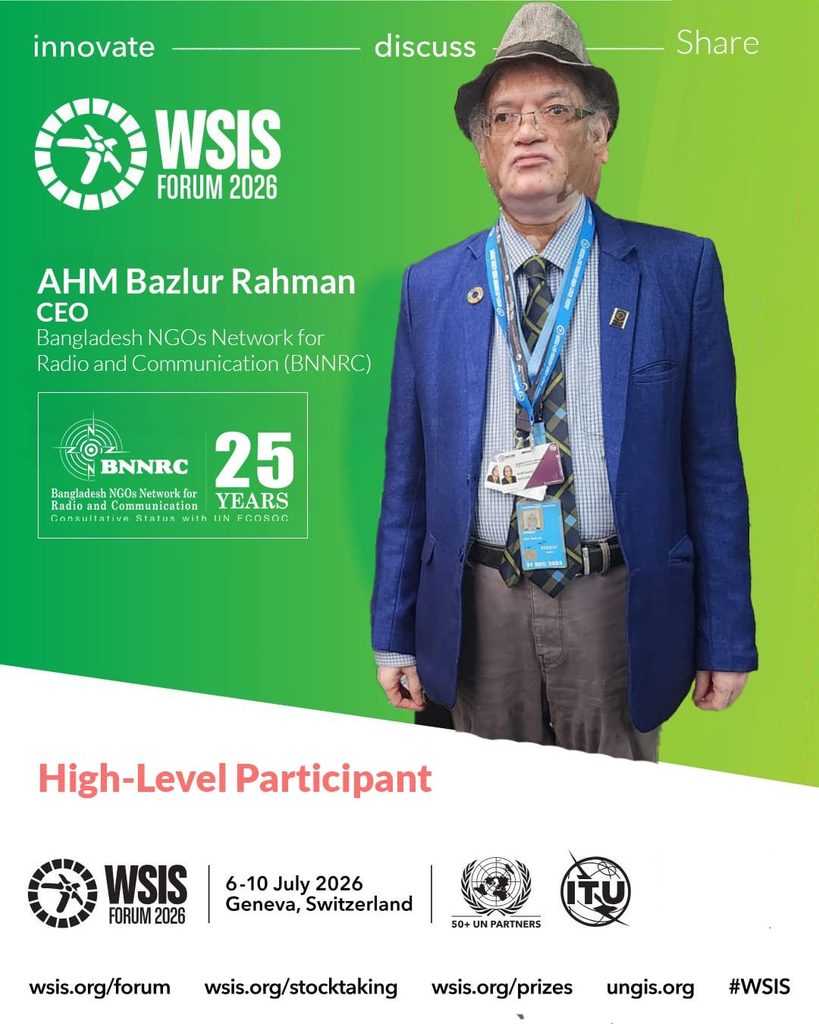
Against this global backdrop, AHM Bazlur Rahman, Specialist in Digital Democracy, Information Integrity & Media Development, Chief Executive Officer of Bangladesh NGOs Network for Radio and Communication (BNNRC), and Ambassador for Responsible Artificial Intelligence (AI) & Antimicrobial Resistance (AMR) for Bangladesh, participated as a high-level speaker at the World Summit on the Information Society (WSIS) Forum 2026.
The WSIS Forum 2026, held from 6 to 10 July 2026 in Geneva, served as a global platform for advancing digital cooperation, reviewing progress on the WSIS Action Lines, and strengthening multistakeholder collaboration in the evolving digital landscape.
The Forum was organized under the renewed mandate of the United Nations General Assembly and recognized as a central mechanism for reviewing and advancing the WSIS vision. Through UN General Assembly Resolution A/RES/80/173, the importance of the WSIS Forum as a global platform for digital cooperation and implementation of WSIS outcomes was reaffirmed.
The Forum was coordinated by the International Telecommunication Union (ITU) and co-organized by ITU, UNESCO, UNDP, and UNCTAD, in partnership with more than fifty United Nations entities, creating a comprehensive multistakeholder environment involving governments, private-sector leaders, civil society organizations, technical communities, academia, youth representatives, and international organizations.
The WSIS Forum continues to serve as a unique global space where policy commitments are connected with practical action. Through its High-Level Track, the Forum brings together ministers, regulators, ambassadors, chief executives, civil society leaders, mayors, and heads of UN agencies to discuss national priorities, share policy experiences, and identify pathways for collective action.
During the Forum, discussions focused on emerging opportunities and challenges shaping the digital future, including artificial intelligence, frontier technologies, digital public infrastructure, cybersecurity, digital inclusion, multilingual digital ecosystems, data governance, online safety, and information integrity.
Representing Bangladesh’s civil society and development perspective, AHM Bazlur Rahman highlighted the importance of ensuring that digital transformation remains inclusive, human-centred, and aligned with democratic values. He emphasized the need to strengthen information integrity, promote responsible AI, bridge digital divides, and ensure that communities are not only consumers of technology but active participants in shaping the digital future.
The WSIS Forum 2026 was particularly significant as it marked the first Forum following the WSIS+20 review process. The event provided an important opportunity for stakeholders to reflect on two decades of digital cooperation and discuss future priorities in line with renewed global commitments.
The Forum featured an expanded High-Level Track, ministerial discussions, thematic sessions, innovation showcases, the WSIS Prizes 2026, exhibitions, and a programme developed through an inclusive Open Consultation Process.
Participants highlighted that the next phase of digital development must address both opportunities and risks. While artificial intelligence and emerging technologies can accelerate development, improve public services, and expand access to knowledge, responsible governance frameworks are essential to address challenges related to misinformation, digital exclusion, privacy, cybersecurity, and ethical technology use.
The Forum reinforced the importance of a collaborative approach where governments, technology companies, civil society organizations, researchers, and communities work together to build a trusted and inclusive digital society.
The participation of BNNRC at WSIS Forum 2026 reflects Bangladesh’s continued engagement in global discussions on digital cooperation, information integrity, media development, and responsible technology governance.
At the conclusion of the Forum, stakeholders emphasized the need for continued action to:
- strengthen inclusive digital governance and multistakeholder cooperation;
- promote responsible and ethical artificial intelligence;
- protect information integrity and public trust;
- expand meaningful digital inclusion for underserved communities;
- enhance digital literacy and online safety;
- ensure that emerging technologies contribute to sustainable development and human well-being.
The WSIS Forum 2026 concluded with a shared commitment that the future of digital transformation must be built on trust, inclusion, accountability, and collaboration, ensuring that technology becomes a force for empowering people and advancing equitable development worldwide.