
Technology-Facilitated Gender-Based Violence: National Consultation Calls for Coordinated Action to Build a Safer Digital Bangladesh
Government, NGOs and stakeholders urge stronger prevention, survivor-centred response and digital safety measures as online violence threatens women, girls and vulnerable communities
As Bangladesh advances rapidly towards a digital society, a new challenge is emerging alongside technological opportunities: Technology-Facilitated Gender-Based Violence (TFGBV). Online harassment, cyberstalking, non-consensual sharing of intimate content, digital threats, and other forms of technology-enabled abuse are increasingly affecting women, girls and marginalized communities, creating serious consequences for their safety, dignity, mental health and participation in digital spaces.
Experts and stakeholders at a national consultation meeting stressed that TFGBV is not only a digital security concern but also a broader human rights, gender equality and development issue requiring coordinated action among government institutions, NGOs, civil society, technology platforms, educational institutions and communities.
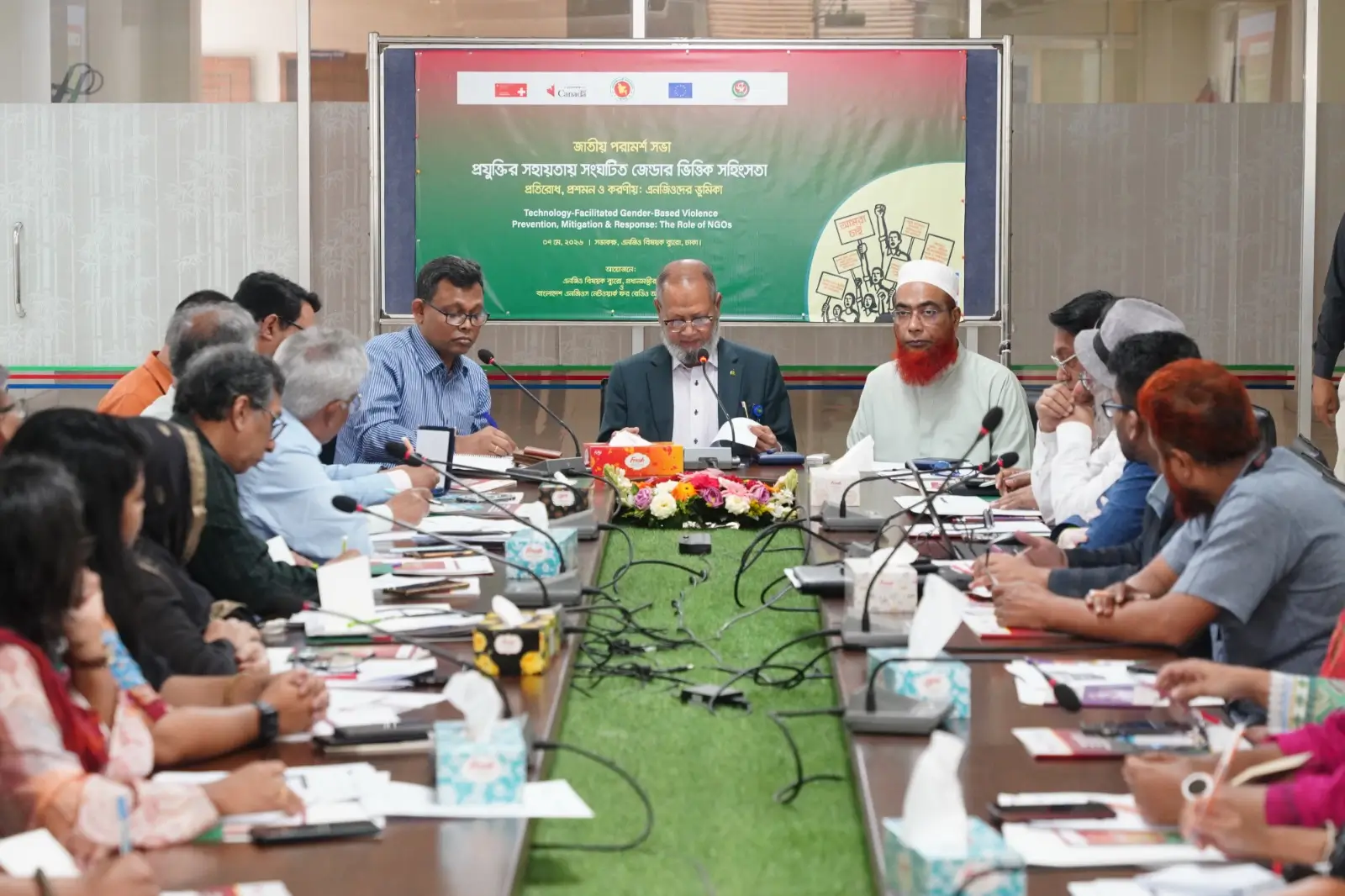
Against this backdrop, the NGO Affairs Bureau under the Prime Minister’s Office and the Bangladesh NGOs Network for Radio and Communication (BNNRC) jointly organized a national consultation titled “TFGBV: Prevention, Mitigation, Necessary Actions, and the Role of NGOs” on 7 May 2026 at the conference room of the NGO Affairs Bureau, Dhaka.
The consultation was organized under the project “Strengthening Resilience Against Technology-Facilitated Gender-Based Violence (TFGBV) and Promoting Digital Development”, implemented under the Nagorikata: Civic Engagement Fund (CEF) Programme, funded by Switzerland, Global Affairs Canada and the European Union, with technical support from GFA Consulting Group.
TFGBV: A Growing Challenge in the Digital Age
The consultation highlighted that while digital technologies have created unprecedented opportunities for communication, education, economic participation and civic engagement, they have also created new pathways for violence and exploitation.
Participants emphasized that victims often face multiple layers of harm, including psychological distress, social stigma, reputational damage, exclusion from digital spaces and barriers to accessing justice.
Speakers stressed that addressing TFGBV requires moving beyond a narrow technology-focused approach and recognising its connection with gender inequality, social norms, human rights and access to justice.
Government Calls for National Coordination
Dr. Mohammad Jakaria, Director General (Secretary), NGO Affairs Bureau, attended the consultation as the Chief Guest and highlighted the importance of a coordinated national response mechanism.
He stated that TFGBV is not merely a technological challenge; rather, it is connected with human rights, gender justice, social protection, mental health, rule of law and sustainable development.
He emphasized the need for stronger collaboration among NGOs, public administration, law enforcement agencies and service providers to establish effective referral mechanisms. He also highlighted the importance of integrating TFGBV issues into district and upazila-level ICT Committees and Cyber Crime Prevention Committees, alongside strengthening data collection and analysis for evidence-based policymaking.
Role of NGOs in Building Digital Resilience
The consultation focused on how NGOs can integrate TFGBV prevention and digital safety measures into their existing and future development programmes.
Barrister Md. Khalilur Rahman Khan, NDC, Director (Joint Secretary), NGO Affairs Bureau, moderated the session and welcomed participants. He emphasized the importance of mainstreaming TFGBV prevention initiatives within NGO programmes and interventions.
Md. Nurul Islam, Capacity Development and Management Expert of the Nagorikata: CEF Programme, highlighted that technology issues must now be integrated into mainstream development planning, similar to gender mainstreaming.
He noted that NGOs working closely with communities can play an important role in promoting digital awareness, responsible technology use and prevention of technology-related violence.
Multi-Stakeholder Dialogue on Prevention and Response
The panel discussion featured:
- Shashwatee Biplob, Associate Director, Gender Justice and Diversity (GJD), BRAC;
- Md. Harun-Or-Rashid, Chief Executive, Lighthouse;
- Zakir Hossain, Chief Executive, Nagorik Uddyog.
A total of 67 representatives from 38 NGOs representing different sectors participated in the consultation.
During the discussion, participants shared practical experiences and recommendations related to:
- Strengthening digital literacy and awareness;
- Supporting survivors through effective referral systems;
- Improving cybercrime response mechanisms;
- Enhancing digital forensic capacity;
- Building safer online environments for children and youth;
- Promoting responsible social media use.
Moving from Victim Blaming to Rights-Based Solutions
In the keynote presentation, AHM Bazlur Rahman, Chief Executive Officer of BNNRC, discussed the nature, risks, impacts and prevention strategies related to TFGBV.
He emphasized that TFGBV does not remain limited to online spaces; its consequences extend into victims’ offline lives, affecting mental health, personal security, social relationships and participation in society.
He called for replacing victim-blaming attitudes with a survivor-centred, compassionate and rights-based approach supported by evidence, awareness and institutional cooperation.
He also highlighted the importance of addressing digital inequality, promoting safe internet practices and ensuring that digital development benefits all sections of society.
Strengthening Support Systems and Community Awareness
Participants highlighted the importance of expanding awareness about the Police Cyber Support for Women service and recommended strengthening grassroots-level outreach of the helpline:
Helpline: 01320-000888
Email: cybersupport.women@police.gov.bd
The consultation also stressed that awareness programmes should not focus only on women and girls. Engaging men, adolescent boys and young digital users is essential to challenge harmful attitudes and promote respectful online behaviour.
Participants recommended:
- Training youth on positive and responsible use of social media;
- Encouraging ethical content creation;
- Engaging schools, local administrations and community organizations;
- Strengthening partnerships between government, NGOs, media and technology stakeholders.
Call for Collective Action
The consultation concluded with a strong call for collective efforts to create a safer and more inclusive digital environment in Bangladesh.
Participants emphasized the need for:
- Stronger prevention mechanisms;
- Accessible survivor support services;
- Effective referral pathways;
- Evidence-based policies;
- Digital safety education;
- Gender-responsive approaches in digital development programmes.
As Bangladesh continues its digital transformation journey, stakeholders agreed that digital progress must go hand in hand with digital safety, gender justice and protection of human rights.
A safer digital Bangladesh will require not only advanced technologies, but also shared responsibility, institutional commitment and meaningful participation from all sectors of society.