
When the Internet Fails, Who Tells Communities What to Do?
A discussion at Asia Pacific Regional (APrIGF) 2026 in Kathmandu examined how community radio, digital networks and local knowledge can help South Asian communities receive trusted information during a crisis.
When a cyclone approaches a coastal community, a warning can travel quickly from a forecasting centre to a mobile phone. But what happens when the electricity fails, the mobile network goes down or a family cannot afford an internet connection?
Even when the warning arrives, another question remains: does it tell people, in a language they understand, where to go and what to do?
Those questions were at the centre of a discussion on community radio and internet resilience at the Asia Pacific Regional Internet Governance Forum (APrIGF) 2026 in Kathmandu, Nepal.
The session brought together community media practitioners and internet governance specialists to consider how people can receive reliable information during disasters, public health emergencies and other crises. The discussion pointed to a practical conclusion: resilience depends on more than restoring a network. It also depends on whether communities can receive, understand and act on information.
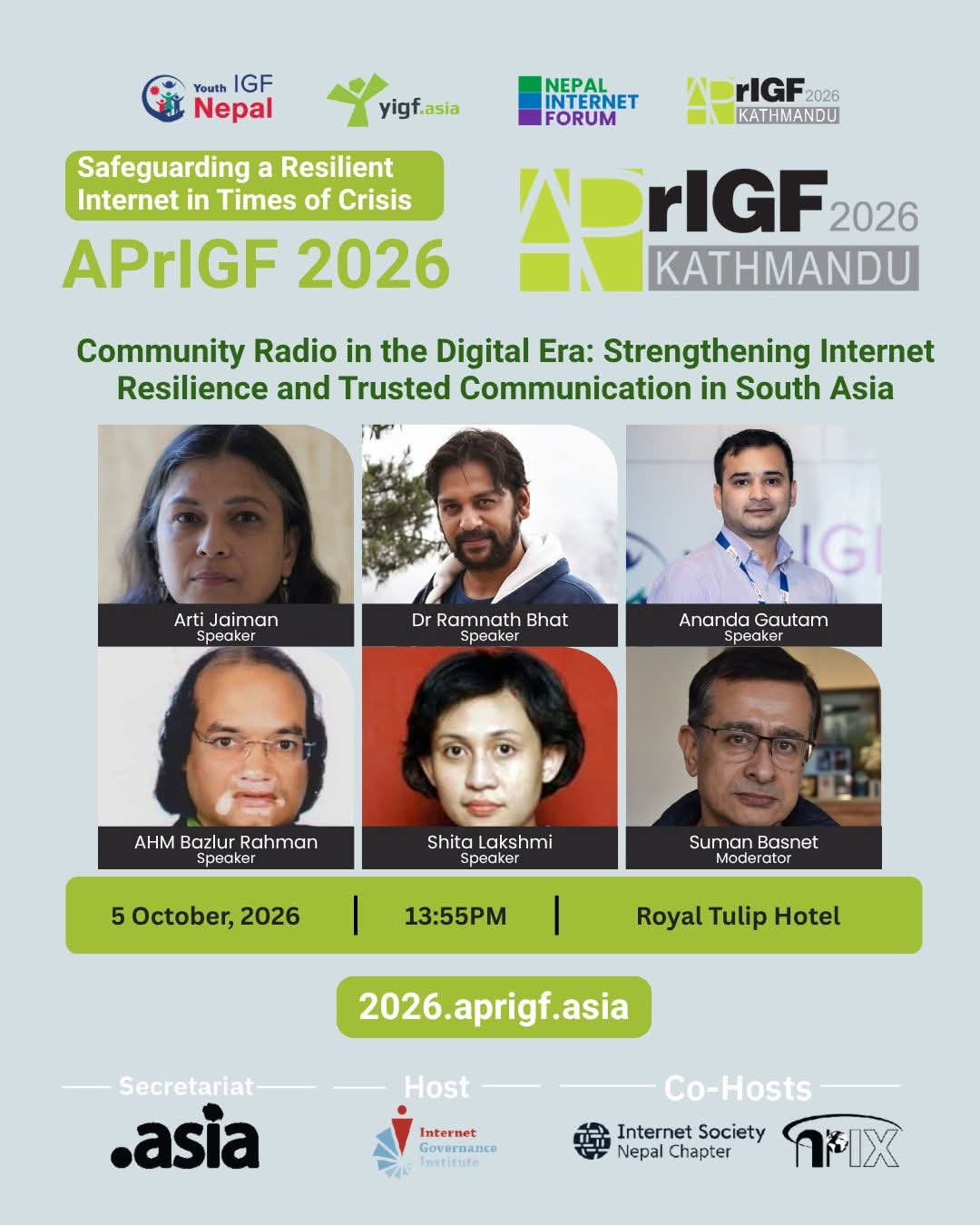
The session, titled “Community Radio in the Digital Era: Strengthening Internet Resilience and Trusted Communication in South Asia,” was held on 5 October 2026 at the Royal Tulip in Lalitpur.
It was organised by AMARC Asia-Pacific, the World Association of Community Radio Broadcasters, in association with the Bangladesh NGOs Network for Radio and Communication (BNNRC) and Community Radio Gurgaon Ki Awaaz, India. The session was moderated by Suman Basnet, Regional Director of AMARC Asia-Pacific.
The panel included Dr. Ramnath Bhat, President of AMARC Asia-Pacific; A. H. M. Bazlur Rahman, Chief Executive Officer of BNNRC; Ananda Gautam of Open Internet Nepal; Arti Jaiman, a community radio practitioner from India; and Shita Laksmi, an internet governance and digital policy practitioner.
The discussion contributed to APrIGF’s broader theme, “Safeguarding a Resilient Internet in Times of Crisis,” and its focus on digital resilience, trust and meaningful connectivity. 2026.aprigf.asia
The gap between a warning and action
South Asia’s growing dependence on digital technology has created new opportunities to communicate during emergencies. Mobile alerts, online platforms and social media can disseminate updates rapidly and reach large audiences.
Yet these systems also have limits. Disasters can damage telecommunications infrastructure and interrupt power supplies. Internet access may be unavailable or unaffordable. Some people may face barriers related to language, disability, age or digital skills.
A warning that appears on a screen is only the beginning. People need to understand the risk, know what action to take and have confidence that the information is reliable. They may also need to ask questions that a standard message cannot answer.
Community radio can help bridge that gap. A local broadcaster can explain an official alert in familiar language, share information about nearby shelters and give listeners an opportunity to raise concerns.
But community radio has vulnerabilities of its own. Stations can lose power, transmitters can be damaged and households may no longer have radio receivers. The session recognised that no single channel can be assumed to work in every crisis.
The policy challenge is to build communication systems in which radio, digital networks, local volunteers and other channels support one another.
Resilience is about people as well as infrastructure
Opening the discussion, Suman Basnet distinguished network connectivity from people’s ability to obtain information they can understand and use. His framing encouraged participants to consider communication as a relationship between infrastructure, institutions and communities.
Dr. Ramnath Bhat argued that crisis communication is a social process as well as a technical one. Referring to the experience of community radio after the Nepal earthquake, he noted that broadcasters can help people maintain social connections and cope with grief while sharing practical information.
Trust, he said, is built through continuing community participation before a disaster. His contribution also drew attention to the importance of community involvement in the ownership and operation of communication infrastructure.
For Bangladesh, these questions are particularly relevant to communities exposed to cyclones, floods, river erosion and other hazards. A. H. M. Bazlur Rahman highlighted the needs of families in remote and underserved areas when electricity, mobile networks or internet services are disrupted.
Community radio, he said, can provide practical information in local languages and dialects, including guidance on evacuation, shelters and relief. He also pointed to listeners’ clubs and community groups as ways for people to communicate their concerns back to decision-makers.
That return flow of information matters. A family may need to report that a road is impassable, a shelter is inaccessible or a warning has not been understood. A communication system becomes more responsive when communities can raise those concerns and receive an answer.
Bangladesh has a policy foundation. Implementation is the test.
Bangladesh has already established a framework for disaster management. Its Standing Orders on Disaster 2019 set out responsibilities for institutions and actors at different stages of disaster risk management. modmr.gov.bd
The country also has an Early Warnings for All roadmap for 2025–2030, intended to strengthen its multi-hazard early warning system. UN agencies describe work towards a National Emergency Telecommunication Plan and a future cell broadcast warning system as part of that effort. www.undrr.org
These are important developments. The existence of a plan, however, does not establish that every person at risk is already receiving an effective warning.
The practical questions are whether people in coastal villages, islands, chars, haor areas, remote hill communities and urban settlements receive timely information; whether they understand it; and whether they can take the recommended action.
For community radio, the question is equally concrete: do stations have the equipment, power, trained staff, access to verified warnings and coordination arrangements needed to operate when a crisis occurs?
Radio and digital platforms can work together
The Kathmandu discussion did not present community radio as a replacement for digital technology. It explored how different channels can reach people with different needs.
Arti Jaiman described how Gurgaon Ki Awaaz, a community radio station in India, made local information available during the COVID-19 pandemic. Although digital services were operating, some community members could not afford internet access or had not previously used it. FM broadcasting offered another way to reach them and allowed listeners to ask questions.
She explained that the station reviewed information from online sources and consulted medical professionals before broadcasting health advice. Her account illustrated that the speed of information must be matched by care in checking it.
Shita Laksmi encouraged community broadcasters to adapt to changing media habits, including those of younger audiences. Online streaming and social media can extend the reach of community content while stations maintain their local relationships.
Ananda Gautam discussed the potential of community networks and local centres to support digital access and skills. He also described radio as a possible fallback when digital services are unavailable, while acknowledging that radio infrastructure itself can be damaged.
Together, these contributions suggest an approach in which verified information is prepared for several channels, with offline options retained for people who cannot use digital services.
Trust cannot be assumed
One audience member challenged a central assumption: why should people automatically trust community radio?
A station’s local presence may help it build relationships, but it does not guarantee accurate reporting. Broadcasters can repeat rumours, misunderstand warnings or share outdated information. During an emergency, errors can affect decisions about safety.
Jaiman described the importance of sustained conversations with listeners, including when information is disputed. Broadcasters, she explained, need to check claims, discuss concerns and correct mistakes. Some of that work continues off air.
The exchange highlighted a responsibility for community media. Trust is built through local engagement, but it must be maintained through verification, transparency and a willingness to answer difficult questions.
Public authorities also have a role. Community broadcasters need timely access to authoritative information and a way to clarify uncertainty, while retaining the independence to question and explain the information they receive.
Bazlur Rahman further emphasised that any use of artificial intelligence in crisis communication should respect human rights and include transparency, accountability and human oversight.
The cost of staying on air
Community broadcasters cannot be expected to operate as dependable emergency channels without resources.
Backup power, resilient transmission equipment, secure premises and trained staff carry costs. So does the work of maintaining relationships with communities, local experts and emergency services before a disaster.
Bazlur Rahman suggested that governments and regulators consider a dedicated window within universal service financing to support community radio resilience. Potential uses discussed included backup power, emergency equipment, resilient transmission, internet connectivity and community listening networks.
The question of funding prompted further discussion. An audience member asked whether telecommunications licensees alone should finance arrangements that could also support broadcasting. Dr. Bhat suggested exploring a broader model involving commercial broadcasters and digital platforms.
No funding model was agreed at the session. Any future mechanism would require scrutiny of its legal basis, eligible costs, sources of funding, public oversight and safeguards for editorial independence.
Speakers’ policy proposals
The discussion produced several proposals for policymakers and practitioners to consider. These were contributions to the dialogue, not formally adopted commitments.
Include community radio in resilience planning
Bazlur Rahman called for community radio to be recognised within national resilience and disaster risk reduction efforts. He proposed clearer coordination among community broadcasters, government agencies, civil society, telecommunications providers, internet service providers and digital platforms.
The aim would be to make local broadcasters part of preparedness before an emergency, with clear channels for receiving verified warnings and relaying community concerns.
Assess communication needs after a disaster
Dr. Bhat proposed a multistakeholder communications assessment after a disaster to identify damaged infrastructure, available channels and feasible responses.
Such an assessment could help authorities and community organisations determine where information is reaching people and where additional support is needed.
Examine temporary emergency licensing
Dr. Bhat also raised the possibility of faster, temporary licensing arrangements for community broadcasting during crises.
Policymakers would need to consider how any such arrangements could operate quickly while remaining proportionate, time-bound and consistent with applicable law.
Explore resilience financing
Bazlur Rahman proposed considering support for community radio through universal service financing, while Dr. Bhat suggested examining a broader range of potential contributors.
The discussion left open the questions of who should contribute, which activities should be eligible and how funding should be governed.
Clarify responsibilities before a crisis
Ananda Gautam called for clear arrangements defining what different actors should do during an emergency. He also raised questions about backup connectivity and the regulation of emergency communication technologies.
Preparedness exercises could help institutions test those arrangements and identify gaps before a real emergency.
Ensure accountable use of digital tools
Bazlur Rahman stressed that AI and other digital tools used in crisis communication should be transparent, respect human rights and remain subject to human oversight.
This matters particularly where automated translation or summarisation could alter the meaning of a warning.
From Kathmandu to practical action
The APrIGF discussion brought community media into a wider conversation about internet governance and resilience. It also demonstrated why the experience of people at the edge of a network should inform decisions made at its centre.
For Bangladesh and its neighbours, the next step is to connect policy commitments with local capacity. That means examining whether stations can stay on air, whether communities have access to receivers, whether warnings are understandable, and whether people can communicate their needs to those responsible for responding.
It also means measuring more than the number of alerts issued or programmes broadcast. A useful assessment would ask whether people received and understood the information, whether they knew what to do, and which communities remained unreached.
Community radio can make a contribution through local languages, established relationships and two-way communication. Its effectiveness will depend on the resources, accountability and cooperation put in place before the next crisis.
A resilient internet is part of that effort. So is a resilient community information system in which people have a trusted way to find out what is happening and what to do next.